Choose Meshy
You want an easier decision path, a hosted interface, and a product hub that helps you move quickly.
Comparison Page
A comparison for readers deciding between a hosted Meshy workflow and a more technical control-oriented path.
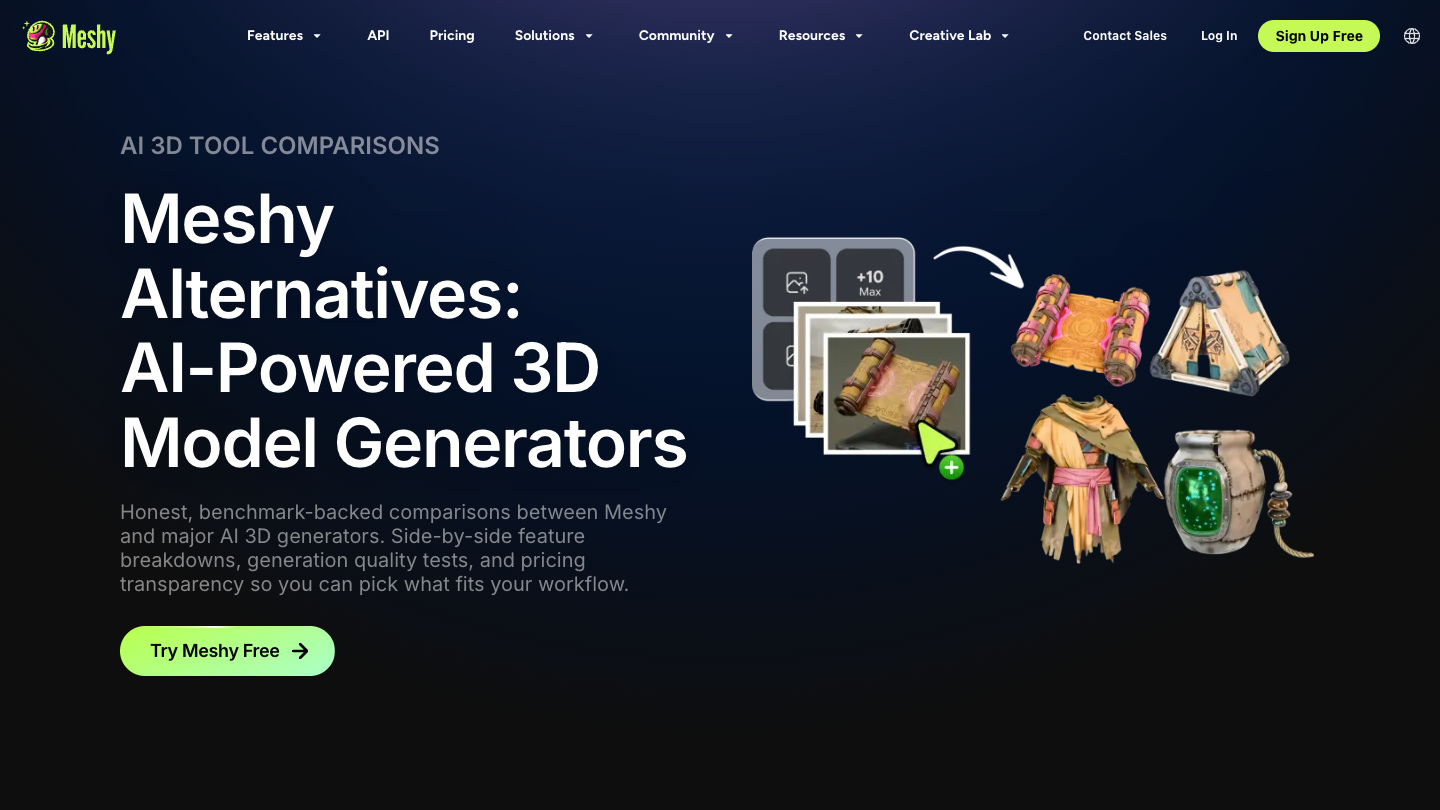
Meshy is the simpler choice when you want a hosted product with a straightforward review and buying path. Hunyuan3D becomes interesting when control, setup tolerance, or technical experimentation matters more than convenience.
Last checked: August 12, 2026
Sources checked: Meshy pricing, Hunyuan3D official site, Hunyuan3D GitHub repo
What may change: Hunyuan3D project status, setup requirements, and Meshy plan limits can change. Confirm the current official pages before deciding.
| Decision point | Meshy | Hunyuan3D |
|---|---|---|
| Workflow style | Hosted, product-led, low-friction | Public project with a more technical setup path |
| Best reason to test first | You want a guided product path | You want to inspect and control more of the environment |
| Setup cost | Account and browser workflow | Local dependencies, hardware, installation, and model files may be required |
| Do not compare by | Assuming convenience means weaker outputs | Assuming control means less cleanup or a simpler license |
Hunyuan3D is the more control-oriented option because its public project includes a repository, installation requirements, and code path that technical users can inspect. Meshy is the more managed option: the service hides more of the environment so a user can focus on the prompt, image, and exported result.
That distinction matters when you need repeatable local experiments, model-side inspection, or control over the runtime. It matters less when your goal is simply to create a usable asset quickly. The public repository also means you must check the current license, hardware requirements, dependencies, and maintenance status yourself; “more open” should not be treated as “drop-in replacement.”
| Control question | Meshy | Hunyuan3D |
|---|---|---|
| Where the work runs | Hosted service | Technical environment based on the public project |
| What you control | Inputs, settings, and downstream cleanup | More of the runtime, dependencies, and local workflow |
| Main tradeoff | Less setup, less environment control | More setup and maintenance responsibility |
The practical difference is not simply hosted versus open. With Meshy, the account, browser interface, generation queue, and export path are managed for you. With Hunyuan3D, the public repository gives a technical user more of the project to inspect, but that also moves responsibility into the user's environment.
Before choosing the local path, check the repository's install requirements, model files, runtime dependencies, GPU expectations, license terms, and update activity. You may gain more control over repeatable experiments and local integration, but you also need to install, maintain, troubleshoot, and validate that environment. Those are real costs even when there is no hosted subscription checkout.
| Before you choose | Question to answer |
|---|---|
| Hardware | Can your current machine run the project within a reasonable time and memory budget? |
| Maintenance | Are you comfortable updating dependencies and repairing the setup when the project changes? |
| Rights | Have you read the current repository and model terms for the asset you plan to create? |
| Integration | Do you need local control, or would a hosted export plus your existing tools be enough? |
| Angle | Meshy | Hunyuan3D |
|---|---|---|
| Workflow style | Hosted, product-led, low-friction | More technical, more control-oriented |
| Best for | Fast evaluation and creator workflows | Users who want technical flexibility |
| Decision trigger | Stay if the hosted path saves time | Switch if control matters more than ease |
You want an easier decision path, a hosted interface, and a product hub that helps you move quickly.
You are willing to trade convenience for more control, setup, or technical exploration.
For a hobby printer, Meshy is the easier first test when the goal is to move from an idea to a file that can be inspected in a slicer. You still need to check wall thickness, bases, non-manifold areas, supports, scale, and first-layer behavior. A hosted workflow does not remove those checks.
Hunyuan3D is worth the setup when local experimentation or deeper control is itself part of the project. It is less attractive when the printer is waiting and the main goal is a quick concept, because environment setup can become a larger task than the model decision. In both cases, the final acceptance test is the same: inspect the mesh, slice it with your intended settings, and decide whether the cleanup is worth the print.
See the idea-to-slicer workflowIf both tools still feel plausible, the real answer is usually in workflow friction and upgrade cost. Revisit the workflow and pricing pages before choosing from instinct alone.
Go to workflow Go to pricingBecause Hunyuan3D is the better counterpoint when you care about open or local control rather than a hosted workflow.
Not always. It depends on whether you want hosted convenience or more control and technical setup.
Compare output quality, export usability, setup burden, and how much manual work each path leaves behind.
Keep Meshy when the hosted path saves more time than any control advantage you expect from a more technical setup.
Keep Meshy when the hosted workflow saves more time than a more technical setup would.
It is more control-oriented because its public project and installation path can be inspected and run in a technical environment. That does not automatically make its license, hardware requirements, or output quality simpler; verify the repository terms and setup before choosing it.